With ColourSpace there are multiple Profiling options for LUT Generation, with the possibility to run very large patch size counts, either via the in-built options, or vis user defined .csv Patch Sets.
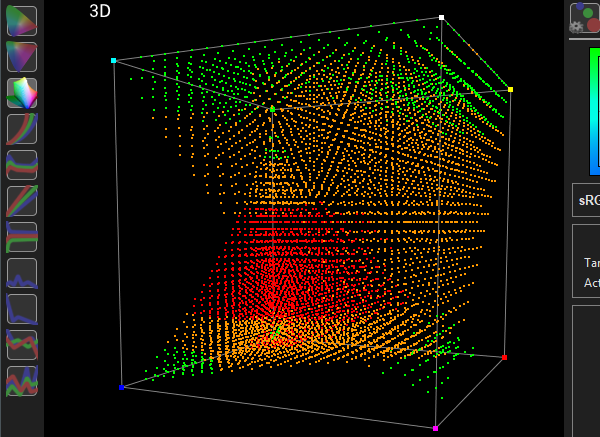
However, care needs to be taken when setting the number of patches to use, with more very often NOT being better.
Profile Size
Within ColourSpace there are two different default Cube based volumetric options, as well as a range of Quick Profiles.
The traditional volumetric profiling option is Cube Based, which defines a standard cube based set of patches with the Cube size slider defining the edge size of the cube such that a value of 33 defines 35,937 patches (33^3).
The second option is Body Centre Cube Based, which defines a smaller offset cube within a larger cube, so that a Cube size value of 33 defines 68,705 patches (a 33^3 cube containing a 32^3 cube within it, with 65 grey scale patches).
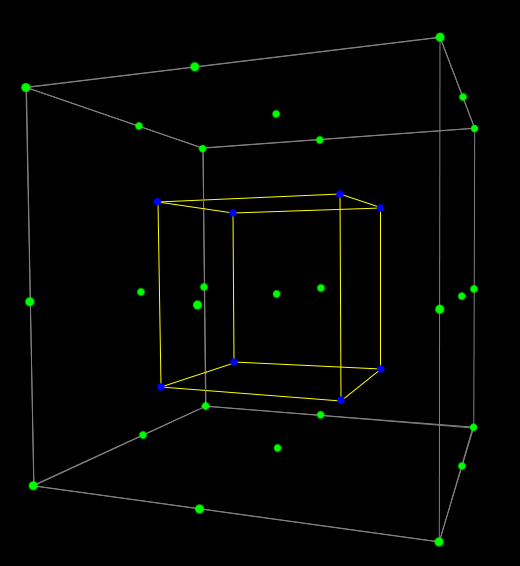
The above shows a 3^3 cube with a 2^3 within it, defining a Body Centre Cube vs. a Standard Cube. The Body Centred Cube adds just 4 patches to the standard Cube's 35 patches, but greatly increases the volumetric coverage achieved. The patch set would also have a 2x-1 grey scale, so 5 grey scale patches.
The initial default max Cube profiling size for ColourSpace is 21, which can be increased to 33 within all license levels via the numeric Cube Size box, matching the native LUT Processing size. With higher ColourSpace license levels (INF/XPT/PRO LMN/LGN & HTX/HTP) it is possible to use the LUT Generation Size option from the Main Menu Preferences drop-down to define internal LUT sizes up to 256^3 and beyond, and the Cube Size slider within Characterisation can then have its maximum size value set via the numeric box to any value up to the defined LUT Generation Size, or 101, whichever is the maximum. The slider will then adopt this value as the new maximum value.
With Body Centre Cubes, the Cube Size value is the outer cube size, so for lower ColourSpace license levels is 17 maximum, as that defines a Grey Axis Size of 33.
Note: With lower ColourSpace license levels the Grey Axis Size tab is purely for information, as it cannot be adjusted.
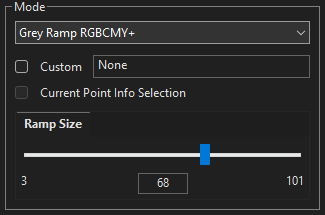
With higher ColourSpace license levels, depending on the pre-set selection there are multiple different tabs selectable depending on the Characterisation option in use, to alter the available profiling mode parameters. For Cube based modes the options are Cube Size and Grey Axis Size. For Quick Profiles, Ramp Size will additionally be available for those Quick Profiles with definable ramps, and Colour Size for Gamut Sweep profiles.
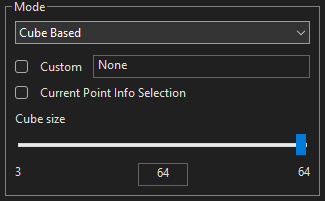
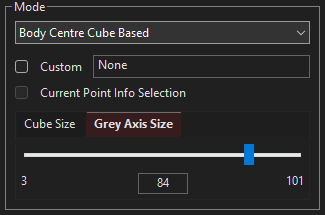

The Cube Size slider defines the patch sequence to be used when either of Cube options are selected from the drop-down list. The value used defines the cube side, so 33 defines 35,937 patches (33^3) for a standard Cube Based selection, and 68,705 patches for a Body Centre Cube Based selection (a 33^3 cube containing a 32^3 cube within it, with 2x-1 - 65 - grey axis patches). Values can be entered via the slider, or via the numeric value box.
The Grey Axis Size, when available, defines an independent number of patches to be used for the grey scale, up to a maximum of 101.
With higher license levels a Red tint to the Grey Axis Size tab defines the Grey Axis Size as being greater than the default Grey Axis Size value based on the defined Cube Size value. If the Cube Size is re-altered, the Grey Axis Size will default back to the default Grey Axis Size for the defined Cube Size.
The BCC (Body Centred Cube) option sets the Grey Axis Size to 2x-1 of the Cube size by default, up to a maximum grey scale size of 33 for lower ColourSpace license levels.
With higher ColourSpace licenses the Grey Axis Size can be set independently, with a Red Tint to the Grey Axis Size tab defining the value as being larger than the default for the defined Cube Size.
The Ramp Size tab enables setting of the ramp size for those Quick Profiles with variable ramp size capabilities.
The Colour Size tab enables setting of the Gamut Sweep size for Gamut Sweep Quick Profiles.
Note: As with all ColourSpace Sliders, clicking to either side of the slider controls will move the slider by a pre-set value, nominally a step of one depending on the granularity of the slider, acting the same as Up/Down/Left/Right buttons.
Very obviously, using large characterisation sizes will greatly increase profiling time, and with that may bring associated displays and probe stabilisation issues due to heat/thermal issues, etc.
- Instability in the display/probe can cause non-monotonic measurements
- Excessive patch granularity with unstable measurement causes artefacts in the generated LUT
- long measurement times can cause heat/thermal drift issues within the display/probe
Using Drift and Stabilisation may not be enough to manage such issues - Having many near black patches can cause issues if the probe's measurements are inaccurate
Often, smaller volumetric patch sets with medium size Grey Axis patch counts will generate superior calibration results, especially on unstable displays.


