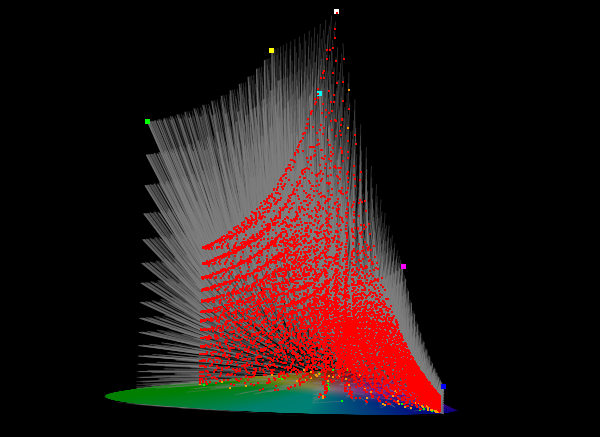
The accuracy of HDR displays is something of a difficult area for many to assess, as the existing metrics used to define calibration accuracy are just not capable of showing true volumetric issues.
This is especially true with WOLEDs, where the additional white pixel causes gamut reduction as brightness increases.
HDR Volumetric Accuracy
The following examples show two HDR displays, both with with a Peak Luma of around 700 nits to 800 nits.
In these charts we have adopted the self-profile approach, enabling a better understanding of a given display's underlying capabilities and issues that will affect potential calibration accuracy. Self Profiling also enables any display to be directly compared to any other display as a direct relative comparison.
This concept stems from a very simple premise - any good display, when in its native, uncalibrated state, should effectively profile to itself very accurately.
Therefore, measuring the RGB primaries, and white point, for any display, and generating a target colour space with those values, a full volumetric profile of the display should map each and every measurement accurately to the target colour space.
The 3D charts below are also have colour coded measurement points, with the default being Green showing points that have a sub-1 dE, Orange showing points are between 1 and 2.3 dE, and Red showing points are above 2.3 dE.
The dE Threshold values can additionally be user defined.


In the above 3D CIE graphs the LCD display shows a relatively good/acceptable level of underlying display volumetric capability, while the WOLED graph shows issues throughout, that become increasingly worse as display brightness increases, caused by the addition of the White pixel.


The second set of graphs have dE Tangent lines included, which show the dE error for each and every point, making the difference a lot more obvious. As can be seen, the issue is both Gamut reduction (desaturation), and a drop in brightness/luminance as the displayed colour attempts to increase in saturation.
The direction of the tangent/error lines defines the issue, with vertical lines signifying a luminance error.


Using the unique normalised 3D CIE Cube graphs of ColourSpace it becomes a lot easier to visualise the volumetric issue with any display. The WOLED graph shows just how much volumetric accuracy is missing.


And again, adding dE Tangent lines helps highlight the errors.
Note: When a single point is selected, all other Tangent lines will be dimmed. Setting a colour value that has not been measured will make all Tangent lines bright.


The last RGB Separation graphs really simplify displaying the issue. As brightness increases the WOLED RGB gamut can't maintain an equal level of brightness with the grey scale (Luma), and clips harshly well before the peak luma of the display.
As can be seen, the LCD is ok, while not perfect, but the WOLED has major issues that are easily apparent, due to the inclusion of the white pixel, as this distorts the standard RGB colour channel relationship - excessively as brightness increases.
Standard RGB OLED displays work well for SDR use, requiring no additional white pixel. Adding the white pixel cause volumetric issues throughout the whole brightness range (including SDR), and causes serious issues with HDR. While the SDR issues can be calibrated out with a high-density 3D LUT via an external LUT box, the HDR issues cannot.
In very simple terms, this means that WOLEDs can never be accurately calibrated for HDR, due to a lack of colour volume...


