A good way to really understand the underlying capabilities of any display is to clear/disable any/all calibration, profiling the display in its native state, and assess the profile matched to itself, making any volumetric issues simple to see.
Any good display should map to itself accurately when in its uncalibrated, native state.
Display Self Verification
An obvious issue with different display technologies is Metameric Failure, as described within the Perceptual Colour Matching page.
However, there are other issues that are less obvious, but can cause image problems that can be very difficult to overcome.
As part of the assessment of display calibration ColourSpace has a unique self-verification capability, enabling any display to be assessed to itself, to better understand a given display's underlying capabilities and issues that will affect potential calibration accuracy.
This concept stems from a very simple premise, as any good display, when in its native and uncalibrated state, should effectively profile to itself very accurately.
To assess underlying issues with any display, clear/disable any/all calibration, and profile the display in its native state, and assess the profile matched to its own native colour space and gamut, which makes any volumetric issues simple to see.
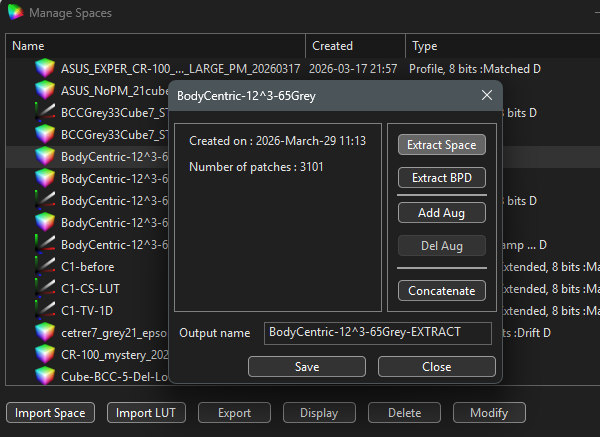
Such Self-Verification is performed by extracting the display's native colour space from the profile using Extract Space.

Profiling a display to itself (to its own native gamut and gamma) really does show the underlying quality of any display...